
E014m
The Size is the Limit
Could Godzilla and King Kong, who are bigger than any dinosaur, exist in real life and destroy the world? For Professor Moustache, there is no such thing as a dumb question
Stand by · pulling the latest frames

Could Godzilla and King Kong, who are bigger than any dinosaur, exist in real life and destroy the world? For Professor Moustache, there is no such thing as a dumb question

Why do humans sweat so much and smell so bad, when I smell so good? For Professor Moustache, there is no such thing as a dumb question.

What does “OK boomer” mean? And what’s a boomer anyway? At full gallop on his time pony, Professor Moustache prances into the past to look at how generations are formed and why they never seem to understand one another. It seems psychological biases and the lazy mechanisms of our brains are to blame.
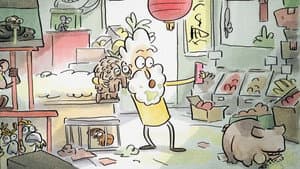
Oh Covid. We were fed up with it at the time and we’ve been confused ever since. Who was to blame again, bats or pangolins? How does a virus travel from animals to humans? Professor Moustache teaches us about the world of coronaviruses. That’s right, Covid-19 is not the only one.

Sometimes when you see a newborn baby, you don’t really know what to say. It doesn’t really look like its parents; it looks more like a crumpled creature. You may think you’re heartless for finding it a little ugly, but Professor Moustache and science are here to explain why! Don’t panic, it’ll get better with time.
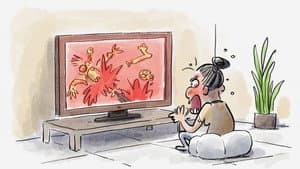
We tend to look at whether young people with violent behaviour play video games. But what does the research say? Professor Moustache delves into some pretty dodgy psychological experiments to find out more about the science behind this association.

Captain Hook had a hook as a hand. Darth Vader had bionic limbs. Films make it look easy to replace severed limbs. But is it that easy in real life? What is scientifically possible when it comes to prosthetics? Professor Moustache takes a look at different innovations.
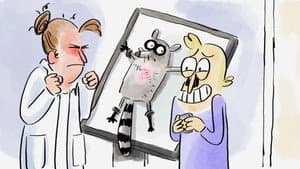
There are researchers who have not only counted the 3 million tiny hairs found on a moth, but who have also studied how often they clean their fur. If it were up to Nathanaël, we’d put an end to pointless studies like these. Luckily Professor Moustache is there to prove him wrong and show him how the scientists behind this researched ended up helping NASA.

If robots in the future developed a conscience, would they want to kill humankind like in “The Terminator”? Let’s imagine for a minute that it was their ultimate goal. Professor Moustache wonders if Skynet could have come up with smarter ways of killing us off, rather than just shooting everyone like in the film.

Everyone is afraid of the singularity – that stage when machines become conscious and inevitably decide to kill us all. Professor Moustache explains that, in order for that to happen, machines would need to develop common sense. And that’s no mean feat when you’re trapped in a robotic body.
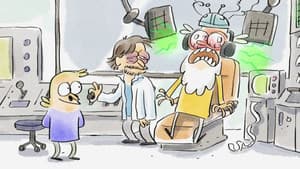
Screaming babies anywhere can be unbearable. Especially on trains. Professor Moustache explains that it’s normal to sometimes want to chuck them out the window when they won’t stop crying. Researchers have found that our brains are wired to go nuts when we hear a baby cry. In fact, it’s essential for their survival.

Why did Mother Nature make babies who won’t let their parents get any sleep? Or who refuse to eat mum’s delicious mashed potatoes? In this episode, a baby goes on trial with evolutionary ethologists at its defense, Professor Moustache as the judge and its parents at their wit’s end.
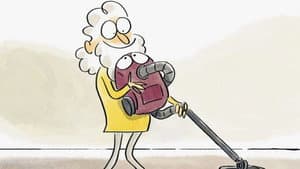
Why did we feel sorry when that man kicked the cute dog robot? But then we feel nothing when we see a broken blender? Researchers have studied this bizarre human weakness; our tendency to see a soul where there is none. Be careful, you’ll never look at your hoover the same way after watching this episode.
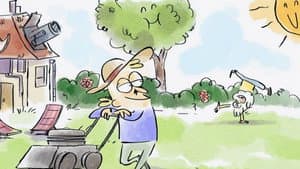
While mowing the lawn, do you ever think about whether grass or flowers can get hurt when they’re cut? What about whether plants talk to insects? Can Professor Moustache mow the lawn without feeling guilty? Don’t let this be an excuse to miss out on your five a day, but science has shown that the plant kingdom communicates – a lot.

Various Inuit legends say that in sub-zero temperatures, it’s possible to carve a tool out of a frozen turd. Without any scatological judgment, brave archeologists decided to test it for themselves and fact-check the legend. Professor Moustache explains.

Is it a good idea to use your saliva to clean things? Like a dummy that fell on the floor, or a stain on a table? How about washing Timothée Chalamet’s sandy face in Dune? Scientifically speaking, given the composition of saliva, it’s actually not such a bad idea.

Thankfully there are researchers who ask fundamental questions. Like John Trinkaus, a US professor who wanted to find out whether children really enjoyed having their photo taken with Father Christmas in a local supermarket. Turns out, his methodology was 99 percent statistics and 1 percent psychology.

People are afraid of taking airplanes because they fly high and can fall around 11 kilometres. But why aren’t they just as scared on a cruise ship? The boat could also sink 11 kilometres deep. Professor Moustache looks at the science of the deep sea to get a better understanding of his underwater phobia. There is no guarantee he’ll cure it, though.

If we’re going to live on the Moon, can we bring our good old Fiat 500 with us? Unfortunately, my friends, terrestrial cars are not cut out for lunar weather conditions. We would need to build entirely new automobiles fit for purpose. Luckily, NASA already did.

Professor Moustache loves John Trinkaus because he tackled so many everyday mysteries with scientific research. For example, what is the percentage of people who actually respect the ten item limit in the supermarket express lane? Or stop their cars at stop signs? Trinkaus, the ultimate pessimist when it comes to human behaviour, had the answers.

Every country has its laws. But what happens when a crime isn’t committed on Earth? What if an astronaut kills a colleague on the International Space Station? And what about on the Moon or Mars? Professor Moustache takes us on an interstellar cruise to explain a few useful treaties and helps us answer these questions.
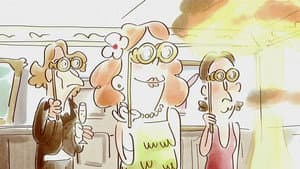
What would happen if an atomic bomb were dropped on Paris? Would those outside the ring highway that surrounds the city make it? According to Professor Moustache, they would, but only if they follow strict instructions given by two Greek researchers on how to survive a blast. Watch out, you’ll have to move quickly…

The tardigrade, an eight-legged micro animal that looks like a teddy bear, can be found everywhere. And Professor Moustache loves them. It may be cute and microscopic, but the tardigrade is extremely resistant! It also only grows at a rate of 3cm per month and uses snails as means of transport.

In the TV show “The Last of Us”, people become zombies after a fungus takes over their brains, which was inspired by something that happens in real life. There is a fungus that does exactly that to ants. But don’t worry, Professor Moustache is here to reassure you that the human brain is a tad more complicated than that of an insect.

If only it were possible for our pets to speak to us and tell us how much they love us… Well, it turns out that scientists have already tried to get monkeys to speak to us using words, signs and symbols. One researcher even managed to recreate the ‘voice’ of a chimpanzee! But would animals actually tell us they love us? Professor Moustache certainly doesn’t think so.

Imagine you’re a tiny ant in a jungle and you find a massive cookie chunk just three metres from your anthill. You rush to grab a piece of the cookie, but how will you find your way back to your anthill? You’ve walked so many zigzags and your eyesight isn’t exactly the sharpest. Professor Moustache dives into the world of myrmecology, the study of ants, to find an answer.

Even though it is a predatory killing machine in many ways, the poor T-Rex has also been a laughing stock because of the size of its arms. Scientists have long wondered why they are so tiny, so Professor Moustache has decided to take a look at their hypotheses.
Doggy Supernose
Professor Moustache finds it a little too easy to make fun of dogs he sees online who would do anything for a biscuit. But if humans were to develop the same sense of smell as dogs, we would quickly realise that actually, humans are totally nose-blind. Maybe we are the ones who should be made fun of?

If there is one sport that science has studied in detail, it’s football. We thought we knew everything there was to know about football players, but then female players came along! And now, researchers are finding surprising differences between the two genders – especially when it comes to behaviour.

It is possible to grow meat in a lab without killing cows, like growing a plant in a pot. Now, Nathanaël dreams of harvesting his steaks along his window sill. But turns out growing meat is more complicated than we think. Who’s here to crush Nathanaël’s dreams? Professor Moustache, of course!